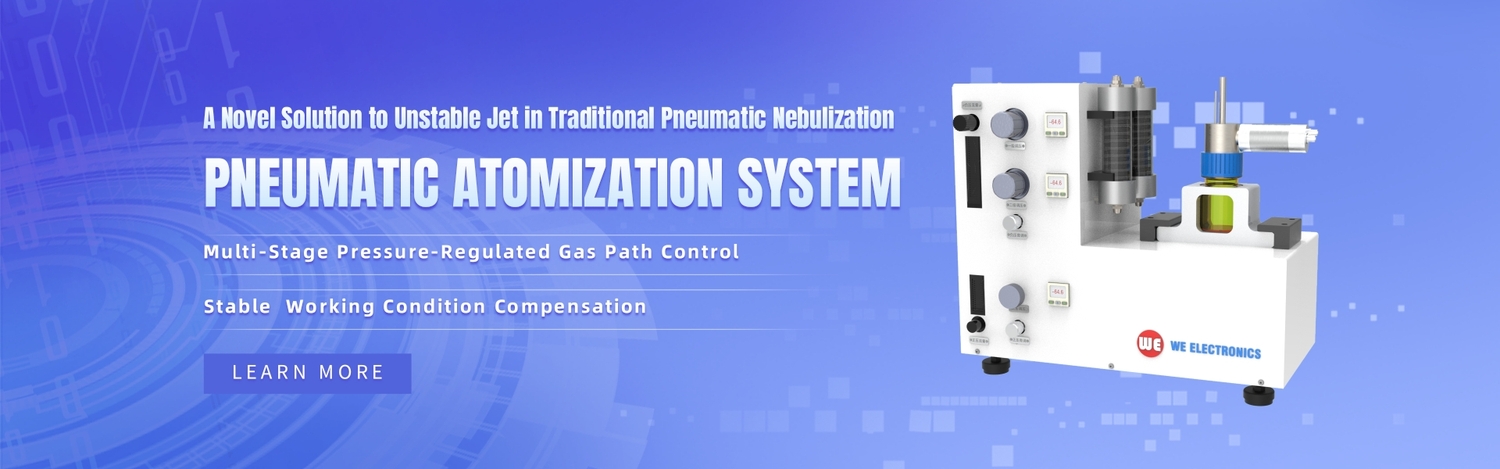
I. Product Overview
The Pneumatic Atomization System (Model: WE-PAS) is a high-precision aerosol generation device based on multi-stage pressure-regulated gas path control technology. It is specifically designed for Aerosol Jet Printing (AJP) and other aerosol application scenarios. Through innovative pneumatic atomization technology and stable aerosol delivery control, this product addresses the industry-wide challenge of unstable jets in traditional pneumatic atomization systems, significantly enhancing the stability and continuity of the atomized jet. It is suitable for high-viscosity ink systems and various complex materials, and is widely used in high-efficiency filter testing, inhaled drug development, environmental simulation, and cutting-edge scientific research.
II. Technical Background
Aerosol Jet Printing (AJP) is a non-contact advanced manufacturing technology that achieves high-precision and composition-controllable printing processes through precise control of micro-droplet transport and deposition. Although traditional pneumatic atomization offers advantages such as effective atomization and compatibility with high-viscosity materials, it is limited by two major technical bottlenecks:
l Gas Path Pressure Fluctuations and Flow Distribution Defects: The flow ratio between the sheath gas and exhaust gas in the virtual impactor is highly sensitive to pressure fluctuations in the gas source. Minor changes can disrupt this balance, causing jet divergence, flickering, or even interruption.
l Internal Working Condition Drift in the Atomization Bottle: Liquid level decline, solvent evaporation, and other factors lead to changes in pressure, concentration, and temperature, further exacerbating flow distribution instability.
The Pneumatic atomization System thoroughly resolves these issues through multi-stage pressure-regulated gas path control and working condition compensation technology, fully unleashing the potential of pneumatic atomization.
III. Core Features
1. Multi-Stage Pressure-Regulated Gas Path Control System
l Utilizes high-precision gas path control modules to achieve precise adjustment and stable output of the atomizing airflow.
l Ensures a constant ratio between sheath gas and exhaust gas in the virtual impactor, guaranteeing consistent and uniform aerosol jet delivery.
2. Stable Aerosol Delivery and Working Condition Compensation
l Compatible with the dedicated Stable Atomization Module (WE-SFM) for real-time adjustment of internal conditions in the atomization bottle.
l Maintains stable pressure, significantly enhancing jet consistency and repeatability.
3. Wide Range of Flow Rate and Viscosity Adaptability
l The aerosol generator supports continuous flow rate adjustment from 0 to 2000 sccm.
l Excellent media compatibility, suitable for various liquids with viscosities up to 1000 cP.
l Compatible with precision single-orifice or multi-orifice nozzles, meeting both polydisperse and monodisperse aerosol generation needs.
4. Modular Design and Expandability
l Offers extensive expandable interfaces supporting external control systems.
l Flexibly integrates with virtual impactors, liquid replenishment devices, and pressure measurement modules for easy system integration and functional expansion.
5. Transparent Visual Design
l Features a glass atomization bottle for real-time observation of liquid levels and operational status.
l Reserved interfaces for pressure measurement, adjustment, and liquid replenishment facilitate operation and monitoring.
IV. Applicable Materials and Application Scenarios
Applicable Materials:
l Water-based solutions, oil-based solutions, suspensions, and certain organic solvents.
l High-viscosity materials (e.g., PAO, DOP, NaCl, PSL microspheres).
l Ink systems containing large particles.
Typical Application Fields:
l Aerosol Jet Printing (AJP) equipment integration.
l High-efficiency filter performance testing.
l Inhaled drug development and nebulized drug delivery systems.
l Environmental simulation aerosol generation.
l Scientific research experiments and instrument calibration.