Product Overview
The WE ELECTRONICS’ M-Series High-Precision Print Head Module (WE-PH) is a new generation high-performance core printing component developed based on core Aerosol Jet Printing (AJP) technology. This module integrates dual-mode atomization adaptation, annular sheath gas focusing, a dual-shutter control system, and innovative jet stabilization technology, dedicated to providing customers with a printing solution capable of achieving micron-level feature sizes, high precision, high stability, and true three-dimensional manufacturing capabilities. The WE-PH module is designed to significantly enhance the efficiency and capabilities in prototyping and small-to-medium batch production for fields such as integrated circuits, advanced electronics, new energy, biomedical, and micro-nano research. It is an ideal manufacturing tool for accelerating the transformation from innovative concepts to functional prototypes and even final products.
Core Features and Advantages
1. Exceptional Printing Precision and Adaptability
1) Feature: Utilizes unique annular sheath gas constraint technology to highly focus aerosol droplets, forming a stable micron-scale jet.
2) Advantages:
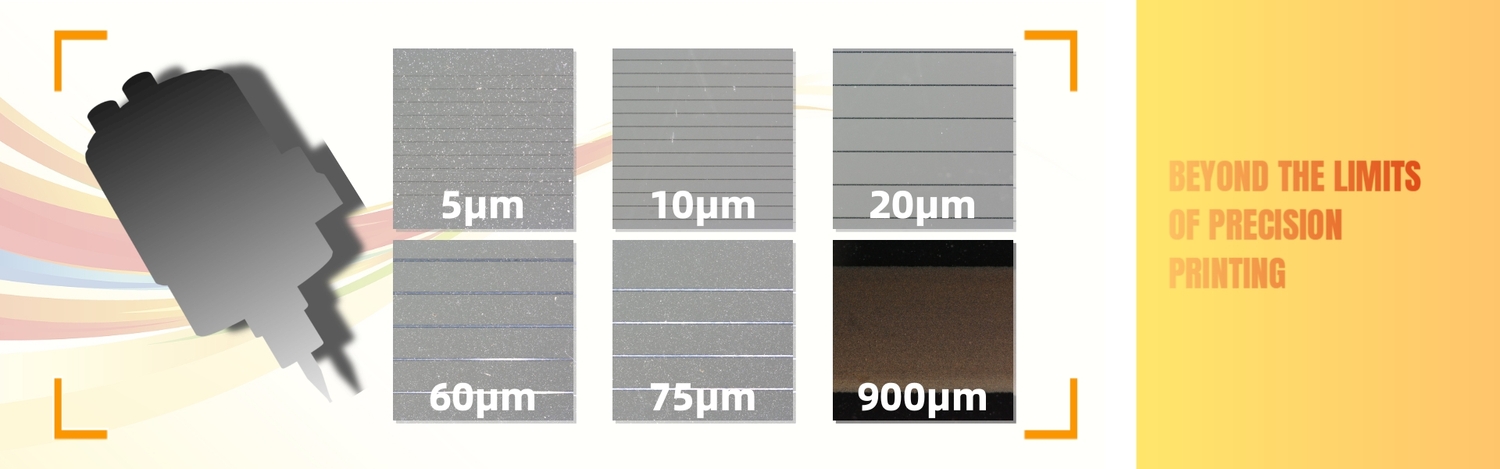
- Ultra-High Precision: Achieves feature sizes as small as 5μm, with in-situ adjustable line width and excellent edge control.
- Ultimate Stability: Effectively mitigates jet instability caused by air path fluctuations or environmental changes, ensuring uniformity and consistency during prolonged continuous printing, significantly improving product yield.
- Broad Substrate Compatibility: Enables high-quality printing on various substrates, including silicon wafers, glass, flexible PCBs, ceramics, and even complex 3D curved shells.
- Effective Splash Suppression: The focused jet significantly inhibits splashing during the printing process, ensuring ultra-high pattern fidelity.
2. Extensive Material Compatibility
1) Feature: Supports two atomization modes: ultrasonic atomization (suitable for low-viscosity solutions) and pneumatic atomization (suitable for high-viscosity slurries).
2) Advantages:
- Wide Viscosity Range: Adapts to various functional materials with a viscosity range of 1-1000 cP, covering everything from low molecular weight solutions to high solid-content nano slurries.
- Simplified Ink Preparation: Eliminates the need for complex additives for printability. Functional materials (such as silver nanowires, CNTs, PZT, epoxy resin, etc.) can be dispersed into solutions/suspensions using common solvents like water or ethanol and printed directly, greatly preserving the material's intrinsic properties.
- Accelerated R&D: Shortens the development cycle for transforming new material lab formulations into printable inks by multiples, allowing researchers to focus on the material itself rather than print adaptability.
3. Millisecond-Response Dual Shutter System
1) Feature: The module can be optionally equipped with integrated mechanical or pneumatic shutters.
2) Advantages:
- Precise Start/Stop: Achieves millisecond-level control of material jet start/stop, fundamentally eliminating leakage, trailing, and bleeding phenomena.
- Fine Doting: Supports high-precision dot matrix, pad, and spaced printing, meeting stringent requirements for electronic packaging.
4. True 3D Manufacturing Capability
1) Feature: Supports direct additive manufacturing from 2D patterns to high-aspect-ratio 3D structures.
2) Advantages:
- 2D Patterns: Precision circuits, antennas, sensors, etc.
- 3D Structures: Can print complex 3D shapes traditionally unachievable, such as micro-needle arrays (for drug delivery) with heights ≥5mm, micro-lattices, spirals, dendritic branches, opening new avenues for manufacturing structurally integrated components.
5. Modularity and Scalability
1) Feature: Provides a variety of specifications of interchangeable nozzles and supports optional functional modules.
2) Advantages:
- Flexible Configuration: Standard nozzles include 200μm, 300μm, and 500μm aperture sizes, expandable to specifications like 100μm and 700μm to meet needs ranging from utmost fineness to efficient coverage.
- Easy Integration and Maintenance: Modular design facilitates quick replacement, cleaning, and upgrades.
Application Fields
This print head module is an ideal manufacturing tool for the following cutting-edge technology fields:
- Electronics and Optoelectronics: High-frequency RF antennas, flexible/stretchable circuits, transistors, transparent conductive electrodes (OLED), various sensors (strain, temperature, biological).
- New Energy: Fuel cell electrodes, solar cell grid lines, micro-supercapacitors, patterned deposition of solid-state battery electrolytes.
- Biomedical and Medical Devices: Customized biosensors, microneedle arrays (for transdermal drug delivery and detection), tissue engineering scaffolds.
- Aerospace and Defense: Embedded sensors, radar-absorbing structures, lightweight drone circuits, structurally integrated components.
- Micro-Nano Manufacturing and Research: MEMS devices, photonic crystals, micro-optical elements, patterned synthesis and research of new materials (e.g., graphene, MXene).